Improvising tasteful blues guitar solos can feel out of reach.
But with the right framework, you can start crafting solos that captivate. In this guide, we’ll explore three tips to play better acoustic blues solos. You’ll learn how to blend chord tones with flashy licks even when the chord progression throws you a curveball.
Let’s dive in!
Tip 1: Lean on Arpeggios to Outline the Chords
Arpeggios are the notes that make up each chord you’re playing over.
Build your phrases around arpeggios to sound connected to the chord progression. To do this, you’ll need to know the chords in the progression and each chords arpeggio. As an example, let’s take a look at the iconic progression from, Nobody Knows You When You’re Down and Out.
| C / E7 | A7 | Dm / A7 | Dm |
| F / F#dim7 | C / A7 | D7 | G7 |
Let’s focus on using the arpeggios for the C, E7 and A7 chords in the first two bars.



When soloing over a C major chord, focus on notes from the C major arpeggio – C, E, G. Do the same for other chords like E7 and A7. You don’t have to rigidly play the arpeggio up and down. But think of it as a framework – arpeggio notes are your priority. Other notes can connect positions and smooth transitions between chords.
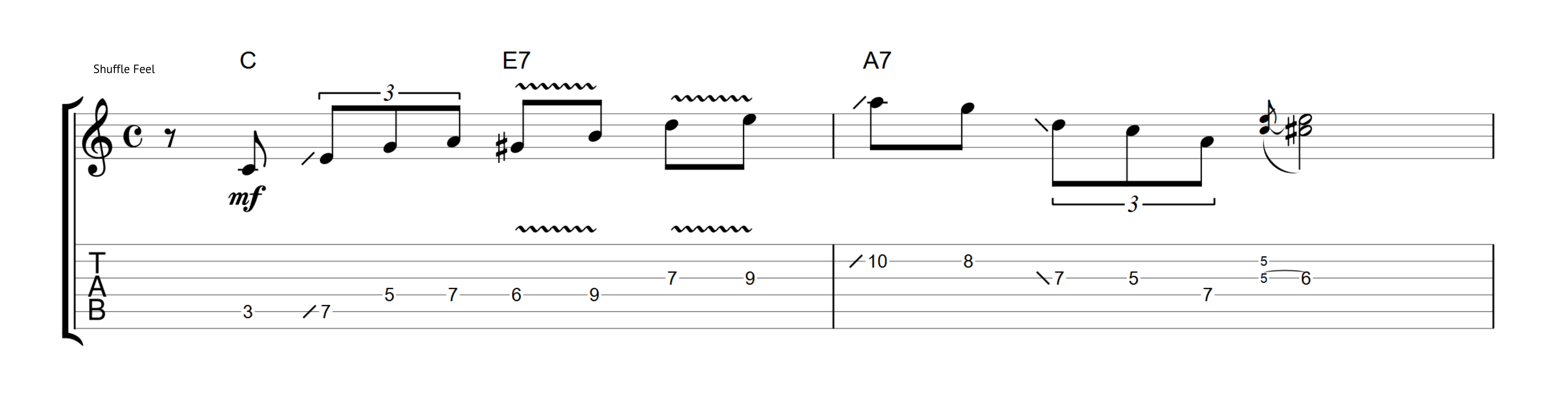
But keeping the arpeggio in mind keeps you grounded in the chord changes.
Your leads will sound aware of the music behind you.
Tip 2: Mix in Classic Blues Licks for Expression
Once you’ve outlined the chords with arpeggios, don’t be afraid to break free and jam!
Time-tested blues licks are your chance to grab attention and show emotion. Let’s see this in action during bars 3-4 of our Down and Out solo example. The chords change from Dm to A7 and back to Dm. Measure 3 follows the chords, while bar 4 is a blatant disregard for, well, just about everything.
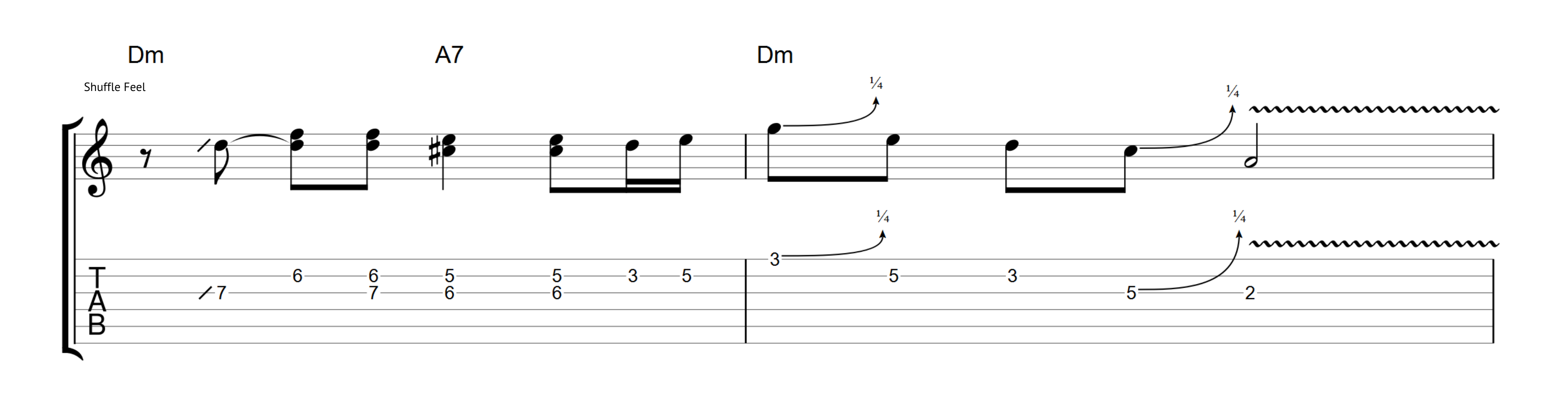
But it works.
The contrast grabs the ear as it builds tension with a little bit of flash. This is all about balancing the connected, aware sound of the chords with a dirty, gritty blues sound.
Tip 3: Keep It Simple When Things Get Complicated
When soloing over complex or unfamiliar chord changes, resist the urge to overthink. Instead, simplify your approach.
Even if the chords are complex and passing by quickly, you can rely on pentatonic patterns you know by heart.
The simplicity of the pentatonic scale strips away so many potential wrong notes. Let’s look at how I used this approach in bars 5-8 where the chords are F to F#dim7 – yikes!
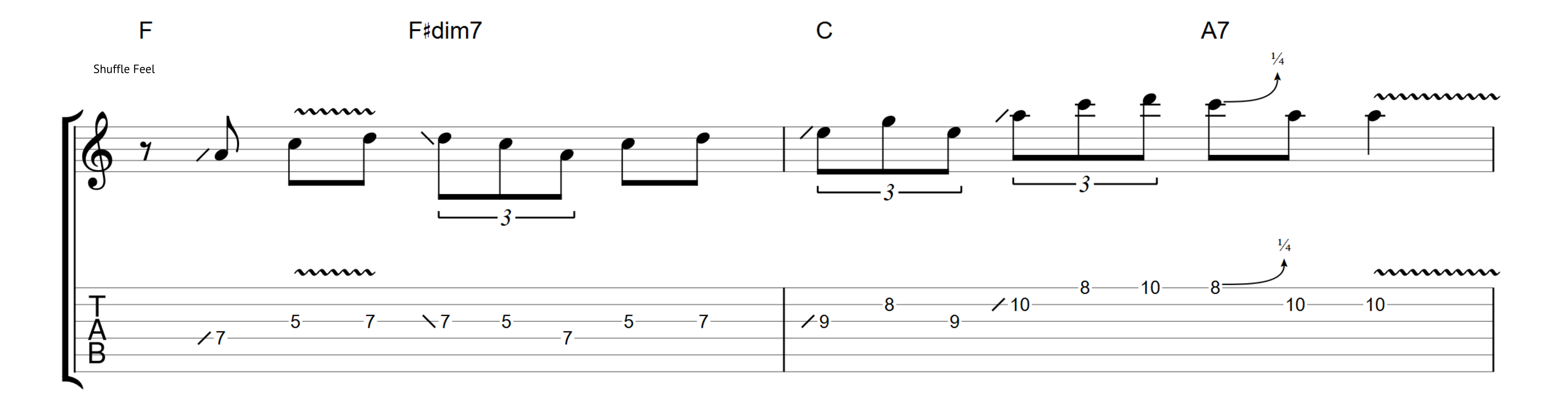

Notice how I leaned into simple pentatonic patterns over the more complicated chords.
Pentatonics may not outline specific chords like arpeggios do. But they provide a trusty framework to solo confidently through the changes. This works especially well in uncharted waters.
You can always go back and work out a more high brow part. But, maybe you don’t want to. There’s something to be said about a simple lead over a complex chord. It works quite well. But having simplification strategies like this in your back pocket gives confidence. When the chord progression throws you a curveball, keep it simple.
And let the pentatonics provide a safety net.
Conclusion
Improvising blues guitar solos can seem scary at first. But, with these three tips we can roll with the punches, even when the chords get a little crazy on us. In your next blues jam, try:
- Using arpeggios to outline chords
- Mixing in classic blues licks
- Simplifying when things get complicated
With this framework, you can craft fresh solos that tell a story. Give it a shot!