The Blues Shuffle Rhythm
Few things are more useful to blues guitarists than the shuffle rhythm.
This rhythm is used throughout the blues and can be heard in legendary songs like Before You Accuse Me and Sweet Home Chicago. It’s important. And it’s an excellent starting point for our study of acoustic blues.
The shuffle rhythm can be broken down into three separate elements: when to play, what to play and how to play.
Let’s start by taking a look at when to play.
When to Play
To understand the shuffle rhythm, it’s best to have a basic understanding of rhythm fundamentals.
Rhythm is all about time, when things happen. To help plot the timeline of a peice of music, everything is divided into bars.
In our example, a bar lasts four quarter notes – a simple four count.
1 2 3 4
If you divide those main beats in half, you then have 8 notes, each lasting 1/8th of the total time allotted to the entire bar. The counting now sounds like this:
1 & 2 & 3 & 4 &
Keep in mind that these 8 notes now fit in the same musical container as our 4 quarter notes mentioned above. The length of the bar didn’t change. We simply played more notes spanning the same amount of musical time.
The magic of the shuffle rhythm comes from the & notes. What if, instead of giving each of the 8 notes equal time, we pushed the & notes a bit closer to the next down beat. Have a listen.
In this case, the off-beats are pushed closer to the down-beats and the result is a loping, flat-tire sound that forms the rhythmic background for much of the blues.
This is the shuffle rhythm your picking hand needs to hold down the entire time you play through the blues shuffle pattern.
Where to Play
After you have the shuffle rhythm down, it’s time to put your fingers on the fretboard.
To start, we’ll play just the A shuffle. To do this, play the open 5th string and fret the 4th string at the 2nd fret. You will play this this miniature chord on the 1 beat and the & of 1.
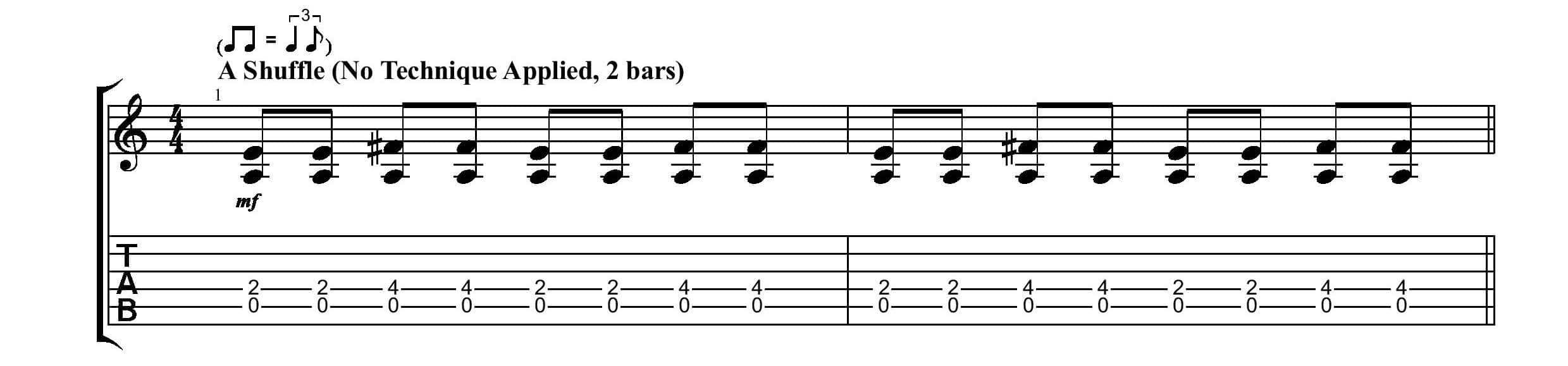
You switch back and forth between these positions on each downbeat (when counting the downbeats are when you say the numbers). Remember to push the second 8th note in every pair until just before the next beat. Have a listen for the sound and rhythm we’re going for.Audio Player00:0000:00Use Up/Down Arrow keys to increase or decrease volume.
While this does sound a little like the blues, something is missing. We need to apply a couple of guitar technqiues to make the shuffle sound like the blues.
How to Play
This is the secret sauce. How you play these notes takes the part from plain to blues. The first guitar technique you’ll need to play the shuffle is called a palm mute.
Applying the Palm Mute
This technique dampens the strings slightly so they don’t ring out when played. Applying the palm mute will instantly take your shuffle from cowboy strums to blues.
The palm mute is achieved by laying the very edge of the palm of your picking hand on the strings of the guitar near the bridge. You’ll want to make sure your palm is positioned just in front of the bridge.
Don’t crush the guitar, rather lay your palm in position and keep the pressure light and constant on the strings. Experiment with different levels of pressure, but remember that you always need to hear the notes. While they may sound dull, you should be able to hear the note under the palm mute.
Applying Staccato
The second guitar technique that really helps your shuffle come to life is another dampening trick. This time, you’re using your fret hand to play the notes staccato.
Staccato: Each note sharply separated from the others.
Each time you strike the strings, slightly raise your finger off the fretboard. Don’t pull off of the strings, just release the pressure from the fretboard just enough to stop the note from sounding. Do this just after you strike each note.
The result will be a short and choppy sounding note coming from the fourth string.
When you see someone using this technique, you’ll notice their fingers seem to bounce slightly on and off of the fretboard as each note is played. That’s what we’re looking for.
Putting it Together
The difficulty comes in coordinating each of these three components into one nice little package.
Practice slowly and perfectly.
Your timing is critically important. I encourage you to practice with a metronome to ensure that you develop good timing while learning the Blues Shuffle.
Once you are able to play the A shuffle in perfect time at a slow tempo along with the metronome, move the pattern to the 4th and 3rd strings to play the D Shuffle. Then, work on switching between them.
Learning the blues shuffle pattern is the first step to playing great blues and sets you up to learn the 12 Bar Blues Formula.
If you’re ready to learn how to plug these shuffles into a 12 Bar Blues, click next below and get started.
Practice Smart. Play On.